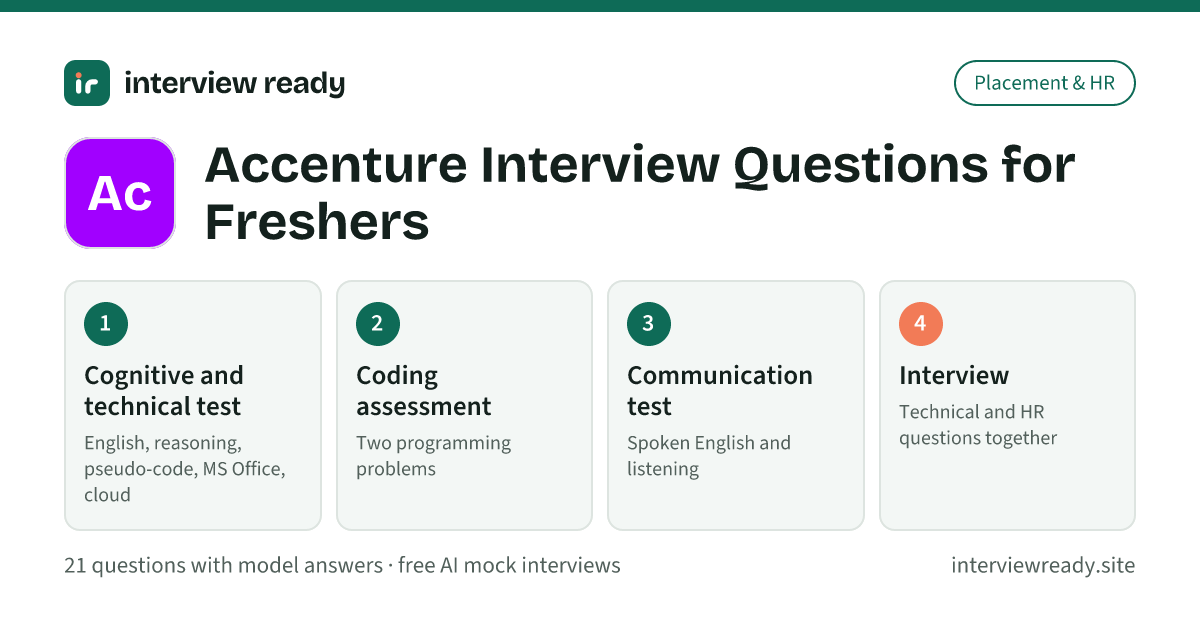
Accenture is one of the largest employers of freshers in India. Its hiring usually includes a cognitive and technical assessment, a coding test, a communication assessment and a final interview that mixes technical and HR questions. These Accenture interview questions cover cloud, networking, pseudo-code and programming basics, situational questions and the HR round, with model answers.
21 questions · Updated
Reading answers is not the same as saying them.Practise Accenture questions out loud and get a score, what you missed and a model answer for each one.
Prepare for the assessment: verbal ability, critical and abstract reasoning, plus technical sections that commonly cover pseudo-code, networking, cloud basics and MS Office.
Practise predicting the output of short pseudo-code snippets with loops, recursion and bitwise operators. These appear often in the Accenture test.
Practise easy coding problems in your chosen language: arrays, strings and simple maths, and make sure your code handles all test cases.
Revise cloud computing (service and deployment models), networking basics and Agile, which Accenture interviewers ask freshers about.
Prepare a clear self-introduction and practise spoken English, since communication is assessed separately.
Technical round
Programming, OOP, DBMS, operating systems and your project, the core of most Accenture fresher interviews.
1. What will this pseudo-code print?
Answer flow · 3 steps
1
Trace it line by line with a small table of variable values.
2
In the example, the loop adds odd values of i (1, 3 and 5) to sum, so it prints 9.
3
In the assessment, watch for loop boundaries (whether the end value is included), integer division, the modulo operator, and whether a variable is updated before or after it is used.
Integer sum = 0
for (each i from 1 to 5)
    if (i mod 2 is not equal to 0)
        sum = sum + i
    end if
end for
Print sum            // Output: 9
2. What are the cloud deployment models?
Answer flow · 4 steps
1
Public cloud: resources owned by a provider such as AWS, Azure or Google Cloud and shared across customers, paid for by use.
2
Private cloud: dedicated to one organisation, on its premises or hosted, offering more control and compliance.
3
Hybrid cloud: a mix of private and public, such as keeping sensitive data on-premises while using public cloud for burst capacity.
4
Multi-cloud: using services from more than one public provider.
3. What is the difference between a virtual machine and a container?
Answer flow · 3 steps
1
A virtual machine runs a full guest operating system on a hypervisor, so it is heavier (gigabytes) and slower to start, but strongly isolated.
2
A container packages an application with its dependencies and shares the host's operating system kernel, so it is lightweight (megabytes) and starts in seconds.
3
Docker builds and runs containers, and Kubernetes manages many containers across machines.
4. What is an IP address, and what is a subnet mask?
Answer flow · 3 steps
1
An IP address identifies a device on a network: IPv4 uses 32 bits written as four numbers, such as 192.168.1.10, and IPv6 uses 128 bits.
2
A subnet mask, such as 255.255.255.0 (or /24), splits the address into a network part and a host part, which tells devices whether another address is on the same local network or must be reached through a router.
3
Private ranges such as 192.168.x.x are used inside local networks.
5. What is DevOps?
Answer flow · 3 steps
1
DevOps is a set of practices that brings development and operations teams together to deliver software faster and more reliably.
2
Key practices include version control, continuous integration (automatically building and testing every change), continuous delivery or deployment, infrastructure as code, monitoring and quick feedback.
3
Common tools are Git, Jenkins or GitHub Actions, Docker, Kubernetes and Terraform.
6. Write a program to find the largest and second largest elements in an array.
Answer flow · 4 steps
1
Walk through the array once with two variables.
2
If an element is greater than the largest, the old largest becomes second; otherwise, if it is greater than the second and not equal to the largest, update the second.
3
This is O(n) and avoids sorting.
4
Handle arrays with fewer than two distinct values.
def top_two(nums):
    first = second = float("-inf")
    for x in nums:
        if x > first:
            first, second = x, first
        elif first > x > second:
            second = x
    return first, second

# top_two([12, 35, 1, 10, 34, 1]) -> (35, 34)
7. Write a program to count the vowels in a string.
Loop through the string and count characters that appear in the set of vowels, after converting to lowercase. Using a set makes each check O(1), so the whole program is O(n).
def count_vowels(s):
    vowels = set("aeiou")
    return sum(1 for ch in s.lower() if ch in vowels)

# count_vowels("Accenture") -> 4
8. What is the difference between GROUP BY and HAVING in SQL?
Answer flow · 3 steps
1
GROUP BY groups rows with the same values in specified columns so aggregate functions such as COUNT or SUM can be applied per group.
2
WHERE filters rows before grouping, while HAVING filters groups after aggregation.
3
For example, SELECT dept, COUNT(*) FROM employees GROUP BY dept HAVING COUNT(*) > 10 lists departments with more than ten employees.
9. What is recursion? What are its advantages and disadvantages?
Answer flow · 3 steps
1
Recursion is when a function calls itself to solve smaller instances of the same problem, with a base case to stop.
2
It makes code for problems like tree traversal, factorial and divide-and-conquer algorithms short and clear.
3
Disadvantages: each call uses stack memory, so deep recursion can cause a stack overflow, and naive recursion can repeat work, which memoisation or iteration can fix.
10. What are the roles and ceremonies in Scrum?
Answer flow · 3 steps
1
Roles: the Product Owner manages the product backlog and priorities, the Scrum Master removes blockers and coaches the process, and the Developers build the product.
2
Ceremonies: sprint planning, the daily stand-up (what I did, what I will do, any blockers), sprint review (demo to stakeholders) and the retrospective (what to improve).
3
Sprints are usually two weeks.
Managerial round
Situations at work, attitude and flexibility. Sometimes combined with the technical or HR round.
11. You are asked to work on a technology you have never used, with a deadline in one week. What will you do?
I would quickly learn the essentials from official documentation and short tutorials, look at how the project already uses it, and ask a teammate for a short walkthrough. I would build a small working piece first to confirm my understanding, keep my lead informed about progress and risks, and ask for help early instead of at the deadline.
12. A client is unhappy with a deliverable. How would you handle it?
Answer flow · 3 steps
1
Listen carefully to understand exactly what is wrong, without becoming defensive.
2
Acknowledge the concern, check it against the agreed requirements, and work with my lead on a plan and timeline to fix it.
3
Keep the client updated until it is resolved, then find out why it happened so the team can prevent it next time.
13. How do you work in a team where members are in different locations?
Answer flow · 3 steps
1
Use clear written communication, keep shared documents and task boards (such as Jira) up to date, schedule overlapping meeting times, and summarise decisions after calls.
2
Be respectful of time zones and cultural differences.
3
Accenture teams are often spread across cities and countries, so this is a common question.
14. What would you do if you are given work that is not related to your skills?
I would accept it positively, learn what is needed, and do it well, because every project builds useful experience such as understanding clients and processes. Once I had proved myself, I would discuss my interests with my manager for future projects.
15. Describe a time you solved a problem creatively.
Answer flow · 3 steps
1
Use a real example with a result.
2
For example: "Our college club tracked event registrations on paper and often double-booked rooms.
3
I built a simple Google Form and Sheet with conditional formatting that flagged clashes, which removed double bookings entirely."
HR round
Questions about Accenture, its hiring programmes, relocation, shifts and your plans.
16. Why do you want to join Accenture?
Be specific: "Accenture works with clients across almost every industry and is investing heavily in cloud, data and AI, so I can learn new technologies and different business domains early. It also has strong training for freshers and a culture that values continuous learning." Mention something recent you read about Accenture.
17. What do you know about Accenture?
Answer flow · 4 steps
1
Accenture is a global professional services company providing consulting, technology, operations and strategy services.
2
It began as the consulting division of the accounting firm Arthur Andersen in the US, became Andersen Consulting and was renamed Accenture in 2001.
3
It is one of the world's largest IT services companies, with India as its largest workforce base.
4
Read one recent news item before the interview.
18. What fresher roles does Accenture hire for?
Common fresher roles include Associate Software Engineer and Packaged App Development Associate, with higher roles for candidates who perform strongly in the coding assessment. Role names, criteria and packages change between hiring drives, so check the current details on the Accenture careers site.
19. Are you willing to relocate and work in shifts?
Accenture has offices in many Indian cities and supports clients worldwide. A clear "yes" works best: "Yes, I am comfortable relocating to any location and working in shifts if the project needs it."
20. Why should we hire you?
Connect your strengths to the role: "I have good programming fundamentals, I learn fast, as I showed by completing an AWS cloud practitioner course on my own, and I communicate clearly. I am flexible about location and technology, and I want a long-term career here."
21. Where do you see yourself in five years?
Show growth inside the company: "I see myself as a skilled consultant in one technology area such as cloud or data, with experience across several client projects, and starting to lead small teams."
Ready to test yourself?Pick your topics and level, answer by voice or text, and get instant feedback. Free.
Company names are trademarks of their respective owners. Interview Ready is an independent practice site and is not affiliated with or endorsed by any company listed here.