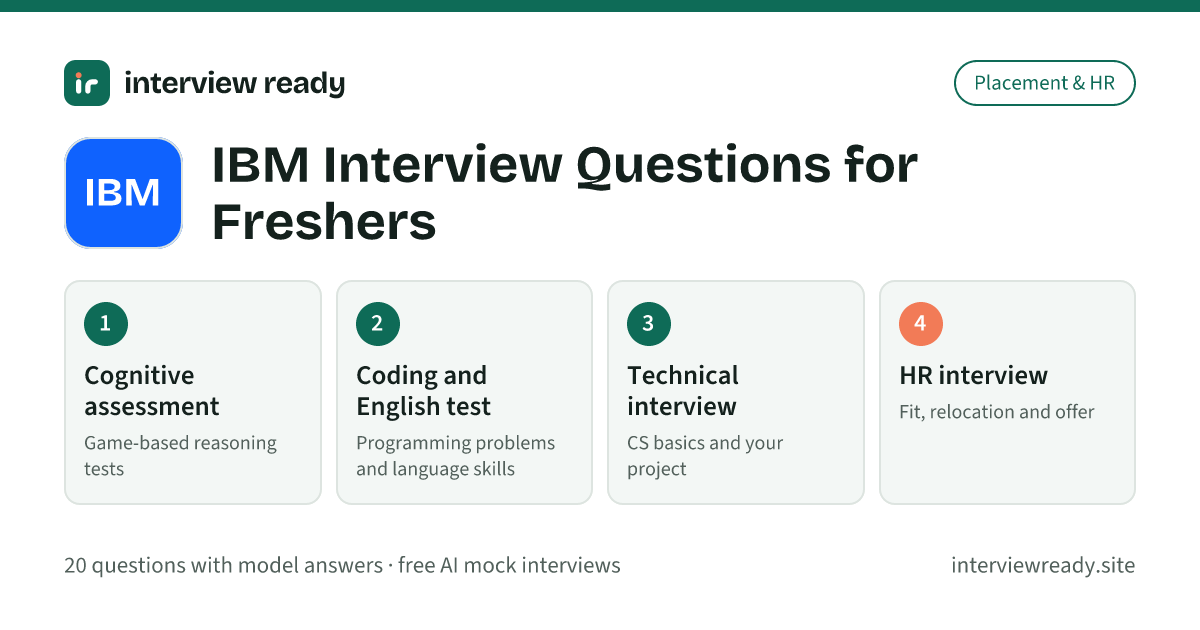
IBM, headquartered in Armonk, New York, hires freshers in India through a process that usually includes game-based cognitive assessments, a coding and English language test, and technical and HR interviews. These IBM interview questions cover Java, Linux, cloud, containers and AI basics, situational questions and the HR round, with model answers.
20 questions · Updated
Reading answers is not the same as saying them.Practise IBM questions out loud and get a score, what you missed and a model answer for each one.
Practise game-based cognitive tests, which measure memory, attention, numerical and logical reasoning. Try sample games online so the format does not surprise you.
Practise easy-to-medium coding problems and revise Java or Python fundamentals, including multithreading basics.
Revise Linux commands, cloud computing, containers and Kubernetes, and AI and machine learning basics, which reflect IBM's focus on hybrid cloud and AI.
Prepare your project explanation and STAR stories for teamwork and problem-solving questions.
Read about IBM: its history, Red Hat, watsonx and IBM Consulting, plus one recent piece of news.
Technical round
Programming, OOP, DBMS, operating systems and your project, the core of most IBM fresher interviews.
1. What are some basic Linux commands you use?
ls lists files, cd changes directory, pwd shows the current directory, mkdir creates a directory, cp and mv copy and move files, rm deletes, cat and less show file contents, grep searches text, chmod changes permissions, ps and top show processes, kill stops a process, df and du show disk usage, and tail -f follows a log file. Most servers run Linux, so these are essential.
2. What is the difference between a monolithic and a microservices architecture?
Answer flow · 3 steps
1
A monolith is one deployable application containing all features; it is simple to build and test at first but becomes hard to scale and change as it grows.
2
Microservices split the application into small, independent services, each owning its data and deployed separately, communicating through APIs or messages.
3
They scale and deploy independently but add complexity in networking, monitoring and data consistency.
3. What is Kubernetes?
Answer flow · 4 steps
1
Kubernetes is an open-source platform for running containers at scale.
2
It schedules containers (in pods) across a cluster of machines, restarts failed ones, scales them up or down, balances traffic with services, and rolls out updates without downtime.
3
You describe the desired state in YAML files and Kubernetes keeps the cluster in that state.
4
Red Hat OpenShift, from IBM's subsidiary, is an enterprise Kubernetes platform.
4. What is hybrid cloud?
Answer flow · 4 steps
1
Hybrid cloud combines on-premises or private cloud infrastructure with one or more public clouds, managed as one environment.
2
Organisations keep sensitive data or legacy systems on-premises while using public cloud for scalability and new services.
3
Containers and Kubernetes make applications portable across these environments.
4
Hybrid cloud is central to IBM's strategy, especially since it acquired Red Hat in 2019.
5. What is the difference between AI, machine learning and deep learning?
Answer flow · 3 steps
1
Artificial intelligence is the broad field of making machines perform tasks that need human-like intelligence.
2
Machine learning is a subset where systems learn patterns from data instead of following hand-written rules, such as predicting customer churn.
3
Deep learning is a subset of machine learning using neural networks with many layers, which powers image recognition, speech and large language models.
6. What is multithreading in Java, and how do you create a thread?
Answer flow · 3 steps
1
Multithreading runs several threads within one program at the same time, making better use of the CPU and keeping applications responsive.
2
You can extend the Thread class or, preferably, implement Runnable or Callable and run tasks with an ExecutorService thread pool.
3
Shared data must be protected with synchronized, locks or concurrent collections to avoid race conditions.
ExecutorService pool = Executors.newFixedThreadPool(2);
pool.submit(() -> System.out.println("Task 1 on " + Thread.currentThread().getName()));
pool.submit(() -> System.out.println("Task 2 on " + Thread.currentThread().getName()));
pool.shutdown();
7. What is the difference between REST and SOAP?
SOAP is a protocol that uses XML messages with a strict structure and a WSDL contract, with built-in standards for security and transactions; it is still common in banking and enterprise systems. REST is an architectural style using HTTP methods and URLs, usually with JSON, and is lighter, faster and easier to use, so most modern web and mobile APIs are REST.
8. Write a binary search program.
Binary search finds a value in a sorted array by comparing it with the middle element and discarding half of the range each time, so it runs in O(log n). Compute the middle as low + (high - low) // 2 to avoid overflow in languages with fixed-size integers.
def binary_search(arr, target):
    low, high = 0, len(arr) - 1
    while low <= high:
        mid = low + (high - low) // 2
        if arr[mid] == target:
            return mid
        if arr[mid] < target:
            low = mid + 1
        else:
            high = mid - 1
    return -1
9. What is a hash table?
Answer flow · 3 steps
1
A hash table stores key-value pairs in an array, using a hash function to turn each key into an index, so inserting, finding and deleting take O(1) time on average.
2
Collisions, when two keys map to the same index, are handled by chaining (a list per slot) or open addressing (probing for another slot).
3
Performance degrades if the hash function is poor or the table is too full, so it is resized as it grows.
10. What is the difference between a compiler and an interpreter?
Answer flow · 3 steps
1
A compiler translates the whole program into machine code (or bytecode) before running, reporting errors at compile time, and the result usually runs faster, as in C and C++.
2
An interpreter translates and runs the program line by line, which makes testing quicker but execution slower, as with traditional Python.
3
Java compiles to bytecode, which the JVM then interprets and compiles just in time.
Managerial round
Situations at work, attitude and flexibility. Sometimes combined with the technical or HR round.
11. How would you handle a production issue reported by a client late at night?
Answer flow · 3 steps
1
Acknowledge it quickly, assess the impact, and follow the support process: check monitoring and logs, apply a safe fix or rollback if possible, and escalate to the right people if needed.
2
Keep the client informed with clear updates.
3
Afterwards, contribute to a root cause analysis so it does not happen again.
12. What would you do if you realised your estimate for a task was wrong?
Tell my lead as soon as I realise it, explain why, give a revised estimate and suggest options such as reducing scope or getting help. Early honesty lets the team plan; hiding it until the deadline causes bigger problems.
13. How do you keep learning new technologies?
Mention specific actions: online courses (IBM offers free learning through IBM SkillsBuild), certifications, documentation, side projects and tech communities. Give one recent example and what you built with it.
14. Tell me about a time you helped a team member.
Use a real example: what they struggled with, how you helped (pairing, explaining, sharing resources) and the result. IBM values collaboration and teamwork.
15. How do you handle repetitive work?
Do it carefully and consistently, and look for ways to automate it with scripts or tools once you understand it well. For example: "In my internship I automated a daily data export with a Python script, which saved an hour every day."
HR round
Questions about IBM, its hiring programmes, relocation, shifts and your plans.
16. Why IBM?
Answer flow · 3 steps
1
Be specific: "IBM has more than a century of innovation, from mainframes to hybrid cloud and AI with watsonx and Red Hat OpenShift.
2
It works with large enterprises on critical systems, and it invests strongly in research and learning.
3
I want to build skills in cloud and AI in a company that shapes how large businesses use technology."
17. What do you know about IBM?
Answer flow · 5 steps
1
International Business Machines began in 1911 as the Computing-Tabulating-Recording Company and was renamed IBM in 1924.
2
It is headquartered in Armonk, New York.
3
Today it focuses on hybrid cloud and AI: software such as Red Hat OpenShift and watsonx, consulting through IBM Consulting, and infrastructure including IBM Z mainframes, which run much of the world's banking transactions.
4
It also leads research in quantum computing.
5
IBM has a large workforce in India.
18. Are you comfortable with relocation and shifts?
IBM has offices across India and supports global clients. A clear "yes, I am flexible about location and shifts" is what the interviewer wants to hear, with honesty about any genuine constraint.
19. Why should IBM hire you?
Link your skills to IBM's focus: "I have strong fundamentals in Java and SQL, I have worked with Docker in my project, and I am completing a cloud certification. I learn quickly, work well in teams and want to grow in cloud and AI, which is exactly where IBM is investing."
20. Do you have any questions for us?
Ask about learning or projects: "What kind of projects do freshers in this role usually join?" or "What learning opportunities are available in the first year?"
Ready to test yourself?Pick your topics and level, answer by voice or text, and get instant feedback. Free.
Company names are trademarks of their respective owners. Interview Ready is an independent practice site and is not affiliated with or endorsed by any company listed here.