Placement & HR

Bank PO Interview Questions and Answers

The interview is the final stage of the IBPS PO and SBI PO exams, and its marks are added to your mains score in the final merit list. These bank PO interview questions cover what panels ask most: your background and why banking, core banking awareness such as CRR, SLR, repo rate, NPAs and KYC, the economy and current affairs, and situations you will face as a branch officer.

34 questions · Updated

Reading answers is not the same as saying them.Practise bank PO questions out loud and get a score, what you missed and a model answer for each one.
Practise free with AI
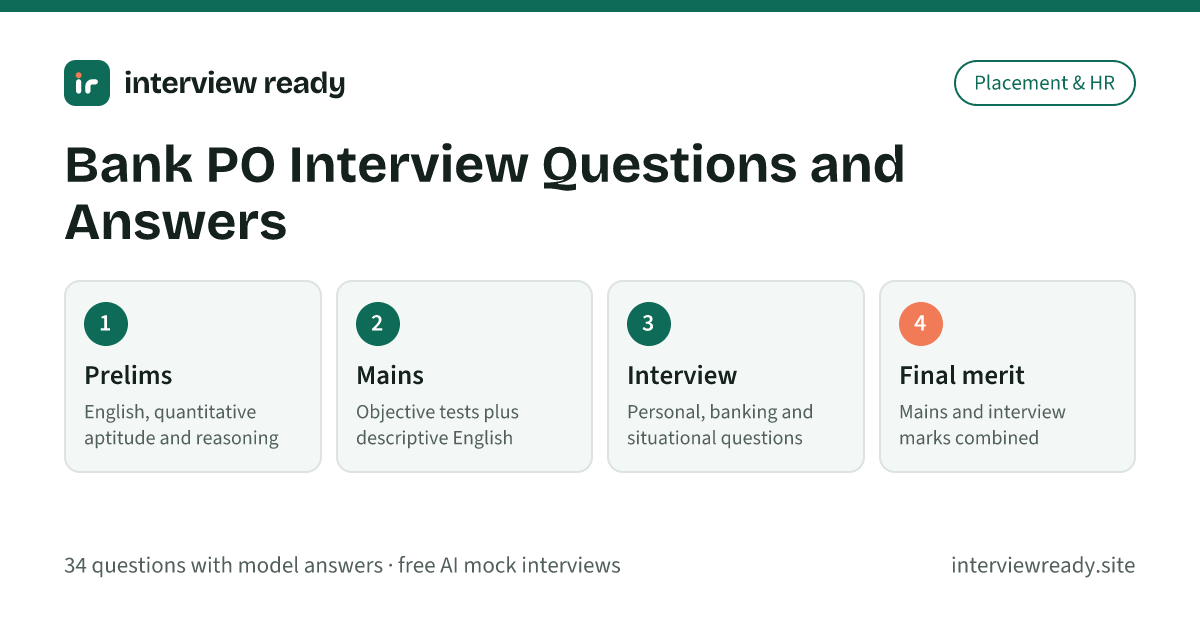
bank PO interview process: 1. Prelims (English, quantitative aptitude and reasoning), 2. Mains (Objective tests plus descriptive English), 3. Interview (Personal, banking and situational questions), 4. Final merit (Mains and interview marks combined).
The bank PO interview process, step by step.

How to prepare for the bank PO interview

Personal and background questions

Your introduction, education, hometown and why you want to be a bank officer.

1. Tell me about yourself.

Answer flow · 4 steps
  1. Give a short introduction covering where you are from, your education, what you have been doing since graduation (preparation, a job or both) and why banking.

  2. For example: "I am from Nashik, Maharashtra.

  3. I completed my B.Com in 2023 and have since been preparing for banking exams while working part-time as an accounts assistant, where I handled bank reconciliations and GST entries.

  4. Seeing how small businesses depend on bank credit made me want to join a public sector bank." Keep it under 90 seconds.

2. Why do you want to join the banking sector?

Answer flow · 3 steps
  1. Give genuine, specific reasons: "Banking lets me work with numbers and with people, which I enjoy.

  2. As a PO in a public sector bank I can contribute to financial inclusion, especially in semi-urban and rural areas where many people still lack access to credit and insurance.

  3. The role also offers job stability, clear career growth and the chance to work across different areas such as credit, operations and recovery." Avoid saying only "job security".

3. You are an engineer. Why do you want to join a bank?

Answer flow · 4 steps
  1. Panels ask this to many candidates.

  2. Show that it is a deliberate choice and that your background helps: "During engineering I realised I enjoy problem-solving that involves people and finance more than core design work.

  3. Banks are now heavily digital, with UPI, mobile banking and data analytics, and an engineering background helps me understand these systems and learn quickly.

  4. I also want to contribute directly to the economy through lending and financial inclusion." Avoid suggesting you could not get an engineering job.

4. Why a public sector bank and not a private bank?

Focus on purpose and reach: "Public sector banks serve the whole country, including rural and remote areas, and implement government schemes such as Jan Dhan, Mudra and the social security schemes, so the work has a direct social impact. They also offer structured career growth, transfers across regions that broaden experience, and job stability." Do not criticise private banks.

5. What does a probationary officer do?

Answer flow · 4 steps
  1. A PO is a junior management officer (Scale I).

  2. During probation, usually two years, they rotate across branch functions: cash and deposits, account opening and KYC, loans and advances, clearing, customer service and sometimes recovery and marketing of products.

  3. After probation they work as assistant managers or officers in charge of departments, and can become branch managers.

  4. POs supervise clerical staff, ensure compliance with rules and grow the bank's business.

6. Tell me about your hometown or home state.

Answer flow · 3 steps
  1. Prepare two or three facts: what it is known for, its main economic activities and something relevant to banking.

  2. For example: "I am from Tiruppur in Tamil Nadu, known as India's knitwear capital.

  3. Its economy runs on textile exports and many small units, so MSME loans and export credit are very important there." Panels often follow up on the local economy, so be ready for one more question.

7. Why should we select you?

Answer flow · 4 steps
  1. Combine skills, attitude and fit: "I am comfortable with numbers and accounts, which my B.Com and work experience show.

  2. I communicate well in English, Hindi and Marathi, which helps with customers.

  3. I am disciplined, as my steady preparation shows, and I am ready to be posted anywhere, including rural branches.

  4. I want a long-term career in banking, not just a stepping stone."

8. Are you willing to work in a rural branch?

Answer flow · 3 steps
  1. The honest and expected answer is yes: "Yes.

  2. Rural postings are an important part of a PO's career and the best way to understand priority sector lending, government schemes and financial inclusion at ground level.

  3. I grew up in a small town, so I am comfortable with it." If you have a genuine constraint, mention it, but show flexibility.

9. If you clear another exam such as UPSC or RBI Grade B later, will you leave?

Be honest but show commitment: "I have chosen banking as my career, and I intend to grow within the bank through internal promotions. I am not preparing for other exams now." Panels know candidates write several exams, so a calm, honest answer is better than an unconvincing denial.

10. How is your graduation subject useful in banking?

Answer flow · 7 steps
  1. Connect your subject to banking functions.

  2. Commerce: accounts, balance sheet analysis for credit appraisal and taxation.

  3. Science or mathematics: analytical thinking, interest and risk calculations.

  4. Engineering: understanding technology, project loans and digital banking.

  5. Agriculture: assessing agricultural loans and rural development.

  6. Arts: communication, understanding society and customer handling.

  7. Give one concrete example.

Banking awareness questions

Core concepts every PO is expected to know, from CRR and SLR to NPAs and payment systems.

11. What is the difference between CRR and SLR?

Answer flow · 4 steps
  1. The Cash Reserve Ratio (CRR) is the percentage of a bank's net demand and time liabilities (NDTL, mainly deposits) that it must keep as cash with the RBI; banks earn no interest on it.

  2. The Statutory Liquidity Ratio (SLR) is the percentage of NDTL that a bank must keep with itself in liquid assets such as cash, gold and approved government securities.

  3. CRR is a monetary policy tool to control liquidity; SLR ensures banks stay solvent and also supports government borrowing.

  4. Check the current rates in the latest RBI policy before your interview.

12. What are the repo rate, reverse repo rate, SDF and MSF?

Answer flow · 4 steps
  1. The repo rate is the rate at which the RBI lends to banks against government securities for short periods; raising it makes borrowing costlier and helps control inflation.

  2. The reverse repo rate was the rate at which the RBI absorbed surplus funds from banks; since 2022 the Standing Deposit Facility (SDF), which does not require the RBI to give collateral, has replaced it as the floor of the policy corridor.

  3. The Marginal Standing Facility (MSF) lets banks borrow overnight from the RBI in emergencies at a rate above the repo rate, and is the ceiling of the corridor.

  4. Know the current repo rate from the latest policy.

13. What is the Monetary Policy Committee?

Answer flow · 4 steps
  1. The Monetary Policy Committee (MPC) decides the repo rate to keep inflation within the target set by the government.

  2. It has six members: three from the RBI, including the Governor, who chairs it and has a casting vote, and three external members appointed by the government.

  3. The inflation target is 4% CPI inflation, with a band of 2% to 6%.

  4. The MPC usually meets six times a year.

14. What is an NPA? How are NPAs classified?

Answer flow · 4 steps
  1. A non-performing asset is a loan where interest or principal has been overdue for more than 90 days.

  2. NPAs are classified as substandard (NPA for up to 12 months), doubtful (substandard for 12 months) and loss assets (identified as uncollectible).

  3. Banks must set aside provisions for NPAs, which reduces profit.

  4. Tools to recover NPAs include the SARFAESI Act, Debt Recovery Tribunals, Lok Adalats, one-time settlements and the Insolvency and Bankruptcy Code.

15. What is priority sector lending?

Answer flow · 4 steps
  1. Priority sector lending (PSL) requires banks to lend a share of their credit to sectors important for development that might otherwise get too little credit.

  2. For domestic commercial banks the overall target is 40% of adjusted net bank credit, with sub-targets for agriculture, micro enterprises and weaker sections.

  3. Categories include agriculture, MSMEs, export credit, education, housing, social infrastructure and renewable energy.

  4. Banks that fall short can buy priority sector lending certificates or must deposit the shortfall in funds such as RIDF.

16. What is KYC, and why is it important?

Answer flow · 3 steps
  1. Know Your Customer is the process of verifying a customer's identity and address when opening an account and periodically after that, using officially valid documents such as Aadhaar, PAN, passport or voter ID, or through video KYC and Central KYC records.

  2. It helps prevent money laundering, terrorist financing, fraud and identity theft, as required by the Prevention of Money Laundering Act.

  3. Accounts are classified by risk, and high-risk accounts are updated more often.

17. What is the difference between NEFT, RTGS, IMPS and UPI?

Answer flow · 4 steps
  1. NEFT (National Electronic Funds Transfer) settles transfers in half-hourly batches and has no minimum amount; it runs 24x7.

  2. RTGS (Real Time Gross Settlement) settles each transfer individually in real time for large amounts, with a minimum of ₹2 lakh, and is also available 24x7.

  3. IMPS (Immediate Payment Service) is an instant 24x7 transfer system run by NPCI, used through mobile and internet banking.

  4. UPI, also by NPCI, allows instant payments using a virtual payment address or QR code from a mobile app, and has become India's most used digital payment system.

18. What is CASA, and why do banks want a high CASA ratio?

Answer flow · 4 steps
  1. CASA stands for current account and savings account deposits.

  2. The CASA ratio is the share of these deposits in a bank's total deposits.

  3. Current accounts pay no interest and savings accounts pay low interest, so CASA is cheap funding compared with fixed deposits.

  4. A higher CASA ratio lowers the bank's cost of funds and improves its net interest margin and profitability.

19. What is Basel III, and what is the capital adequacy ratio?

Answer flow · 4 steps
  1. Basel III is a set of international banking rules developed after the 2008 financial crisis to make banks safer by requiring more and better-quality capital, liquidity buffers and limits on leverage.

  2. The capital adequacy ratio (CRAR) is a bank's capital as a percentage of its risk-weighted assets.

  3. RBI requires Indian banks to maintain a CRAR of 9% plus a capital conservation buffer of 2.5%, higher than the Basel minimum.

  4. Basel III also introduced the liquidity coverage ratio and net stable funding ratio.

20. What are payments banks and small finance banks?

Answer flow · 4 steps
  1. Payments banks can accept deposits up to a limit per customer (currently ₹2 lakh), offer remittances, debit cards and mobile banking, but cannot lend or issue credit cards; examples include India Post Payments Bank and Airtel Payments Bank.

  2. Small finance banks are full banks with a focus on underserved customers: they can accept deposits and lend, must give a large share of loans to the priority sector and many small-ticket loans.

  3. Examples include AU Small Finance Bank and Ujjivan Small Finance Bank.

  4. Both were created to promote financial inclusion.

21. What is financial inclusion? Name some schemes that support it.

Answer flow · 3 steps
  1. Financial inclusion means giving everyone, especially the poor and rural population, affordable access to banking, credit, insurance and pensions.

  2. Key schemes include Pradhan Mantri Jan Dhan Yojana (zero-balance accounts with RuPay cards, launched in 2014), Pradhan Mantri Jeevan Jyoti Bima Yojana (life insurance), Pradhan Mantri Suraksha Bima Yojana (accident insurance), Atal Pension Yojana, Pradhan Mantri Mudra Yojana (loans to micro enterprises in Shishu, Kishore, Tarun and Tarun Plus categories) and Stand-Up India.

  3. Business correspondents and UPI have extended access further.

22. What is deposit insurance, and how much is covered?

Answer flow · 4 steps
  1. Deposit insurance is provided by the Deposit Insurance and Credit Guarantee Corporation (DICGC), a subsidiary of the RBI.

  2. It covers deposits in all commercial banks, including foreign bank branches, small finance and payments banks, and most cooperative banks, up to ₹5 lakh per depositor per bank, including principal and interest.

  3. Savings, current, fixed and recurring deposits are covered.

  4. The premium is paid by the banks, not the depositors.

23. What is the difference between MCLR and EBLR?

Answer flow · 3 steps
  1. The Marginal Cost of Funds based Lending Rate (MCLR), introduced in 2016, is an internal benchmark each bank calculates from its own cost of funds.

  2. Since October 2019, RBI has required banks to link new floating-rate retail loans (such as home and personal loans) and loans to MSMEs to an external benchmark (EBLR), usually the repo rate, so that changes in policy rates pass on to borrowers faster and more transparently.

  3. Older loans may still be linked to MCLR or the base rate.

24. What are the SARFAESI Act and the Insolvency and Bankruptcy Code?

The SARFAESI Act, 2002 allows banks to take possession of and sell secured assets of defaulting borrowers without going to court, after giving notice, generally for loans above ₹1 lakh where the account is an NPA. The Insolvency and Bankruptcy Code, 2016 provides a time-bound process to resolve insolvency of companies through the National Company Law Tribunal, where a resolution professional manages the company and creditors decide on a resolution plan or liquidation.

25. What is the difference between a bank and an NBFC?

Answer flow · 3 steps
  1. A bank can accept demand deposits (savings and current accounts), is part of the payment and settlement system, can issue cheques, must maintain CRR and SLR, and its deposits are insured by DICGC.

  2. A non-banking financial company (NBFC) is registered under the Companies Act and regulated by the RBI; it lends and invests but cannot accept demand deposits or issue cheques, does not maintain CRR, and its deposits (if any) are not covered by DICGC insurance.

  3. Examples include Bajaj Finance and Muthoot Finance.

Economy, current affairs and situational questions

Policy, the economy and how you would handle real situations in a branch.

26. What is inflation, and how does the RBI control it?

Answer flow · 4 steps
  1. Inflation is the rise in the general price level over time, which reduces purchasing power.

  2. India measures it mainly with the Consumer Price Index (CPI), which is also the RBI's target measure, and the Wholesale Price Index (WPI).

  3. The RBI controls inflation mainly by changing the repo rate: raising it makes loans costlier, reducing spending and demand.

  4. It also uses CRR, open market operations and liquidity tools to manage the money supply.

27. What is the difference between monetary policy and fiscal policy?

Answer flow · 3 steps
  1. Monetary policy is run by the RBI and controls money supply and interest rates through tools such as the repo rate, CRR and open market operations, mainly to control inflation and support growth.

  2. Fiscal policy is run by the government and covers taxation, public spending and borrowing, announced mainly through the Union Budget.

  3. The fiscal deficit, the gap between the government's total spending and its income excluding borrowings, is a key fiscal indicator.

28. What is the digital rupee?

Answer flow · 4 steps
  1. The digital rupee (e₹) is India's central bank digital currency (CBDC), issued by the RBI in digital form.

  2. It is legal tender like cash, but held in a digital wallet.

  3. The RBI launched pilots in 2022: a wholesale version for interbank settlement and a retail version for individuals and merchants, distributed through banks.

  4. Unlike UPI, which moves money between bank accounts, the e₹ is the money itself, similar to cash in digital form.

29. Tell me about the public sector bank mergers.

Answer flow · 4 steps
  1. In 2019 the government announced the merger of ten public sector banks into four, effective 1 April 2020: Oriental Bank of Commerce and United Bank of India into Punjab National Bank; Syndicate Bank into Canara Bank; Andhra Bank and Corporation Bank into Union Bank of India; and Allahabad Bank into Indian Bank.

  2. Earlier, Vijaya Bank and Dena Bank merged into Bank of Baroda in 2019, and SBI's associate banks merged into SBI in 2017.

  3. India now has 12 public sector banks.

  4. The aim was to create stronger banks with better capital, reach and efficiency.

30. A customer's account was debited but the ATM did not dispense cash. They are angry. What will you do?

Answer flow · 4 steps
  1. I would stay calm, listen and apologise for the inconvenience, then note the details (card, ATM, time and amount) and register a complaint immediately.

  2. I would explain that under RBI rules, failed ATM transactions must be reversed within five working days (T+5), and the bank must pay compensation of ₹100 per day of delay beyond that.

  3. I would give them the complaint number and follow up until it is resolved.

  4. Panels test whether you know the rules and treat customers with empathy.

31. An elderly customer does not know how to use digital banking and keeps visiting the branch. How will you help?

Answer flow · 3 steps
  1. I would treat them patiently and respectfully, help them with what they need, and, if they want, slowly show them simple options such as using the passbook printer, an ATM or a basic UPI payment, with a family member present if possible.

  2. I would also tell them about doorstep banking services for senior citizens and remind them never to share their OTP or PIN.

  3. Financial inclusion includes making sure no customer feels excluded by technology.

32. A borrower offers you a gift for sanctioning their loan quickly. What will you do?

Answer flow · 3 steps
  1. I would politely but firmly refuse the gift and explain that the loan will be processed according to the bank's rules and timelines.

  2. If they persisted or offered something significant, I would report it to my branch manager as per the bank's vigilance guidelines.

  3. Integrity is non-negotiable for a bank officer, and panels want to hear that clearly.

33. How would you increase deposits in a rural branch?

I would hold financial literacy camps with self-help groups, farmers and schools, open accounts under Jan Dhan and link them to government benefits, promote recurring deposits and small savings products suited to seasonal incomes, use business correspondents to reach remote villages, and encourage UPI and RuPay usage. Building trust through good service and quick resolution of complaints also brings more customers through word of mouth.

34. How do you keep yourself updated on banking and current affairs?

Mention specific sources: "I read The Hindu or the Economic Times daily, especially the business and economy pages, follow RBI press releases and monetary policy statements, and revise monthly current affairs compilations. I keep short notes on banking news such as RBI policy changes, new schemes and bank mergers." Then be ready for a question on any recent banking news.

Ready to test yourself?Pick your topics and level, answer by voice or text, and get instant feedback. Free.
Start a mock interview

HR round, company and bank interview questions

Interview questions by field