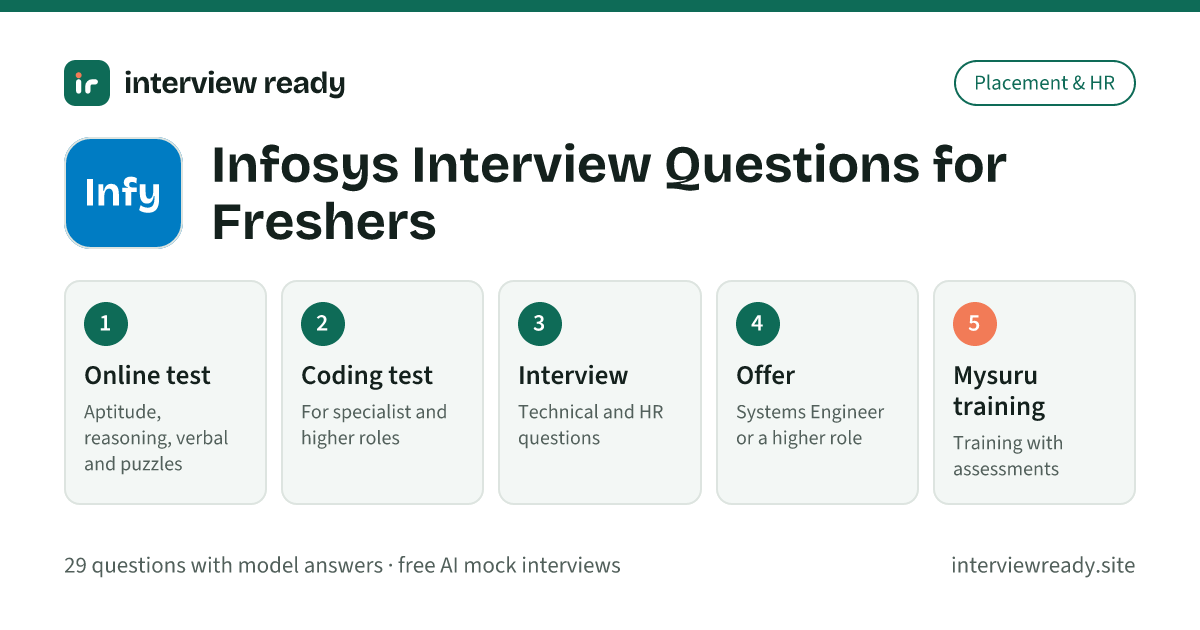
Infosys hires freshers mainly as Systems Engineers, with higher roles such as Digital Specialist Engineer and Specialist Programmer for strong coders, through an online test followed by an interview. These Infosys interview questions cover the technical round (OOP, SQL, operating systems, networks and simple programs), situational questions and the HR round, with model answers.
29 questions · Updated
Reading answers is not the same as saying them.Practise Infosys questions out loud and get a score, what you missed and a model answer for each one.
Prepare for the online test: quantitative aptitude, logical reasoning (Infosys tests often include puzzles and pattern questions), verbal ability and, for higher roles, coding problems.
Revise core Java or Python, OOP (overloading versus overriding, constructors), DBMS and SQL (ACID, DELETE versus TRUNCATE, duplicate records), operating systems (deadlock, paging) and networking basics.
Practise writing simple programs by hand: reversing a string, Fibonacci, prime numbers, counting vowels and finding duplicates in an array.
Know your project and every technology on your resume. Infosys interviewers often pick one line from your resume and go deep.
Read about Infosys: its founders, the Mysuru training campus, Finacle, Infosys Topaz and Cobalt, and its C-LIFE values.
Keep your communication simple and clear. For the Systems Engineer role, attitude and communication matter as much as technical depth.
Technical round
Programming, OOP, DBMS, operating systems and your project, the core of most Infosys fresher interviews.
1. Explain your project and your role in it.
Answer flow · 4 steps
1
Explain the problem, the solution, the technologies, what you personally built and one challenge.
2
For example: "We built a food-waste app that connects restaurants with NGOs.
3
I built the Node.js API and MongoDB schema, and integrated Google Maps to show nearby NGOs.
4
The hard part was notifying the nearest NGO quickly, which we solved with a geospatial index." Be ready to explain any technology you name.
2. What is the difference between method overloading and method overriding?
Answer flow · 3 steps
1
Overloading means several methods in the same class share a name but have different parameter lists; it is resolved at compile time (static polymorphism).
2
Overriding means a subclass provides its own version of a method with the same signature as in the parent class; it is resolved at run time based on the actual object (dynamic polymorphism).
3
Overriding needs inheritance; overloading does not.
class Calculator {
    int add(int a, int b) { return a + b; }            // overloading
    double add(double a, double b) { return a + b; }   // same name, different parameters
}

class Animal { void sound() { System.out.println("Some sound"); } }
class Dog extends Animal {
    @Override
    void sound() { System.out.println("Bark"); }       // overriding
}
3. What is a constructor? What are its types?
Answer flow · 5 steps
1
A constructor is a special method with the same name as the class and no return type, called automatically when an object is created to initialise it.
2
A default constructor takes no arguments; Java provides one only if you write no constructor.
3
A parameterised constructor takes arguments to set initial values.
4
Constructors can be overloaded, and one can call another using this().
5
C++ also has copy constructors; in Java you write one yourself if needed.
4. What is the difference between == and equals() in Java?
Answer flow · 4 steps
1
For objects, == checks whether two references point to the same object in memory, while equals() checks whether two objects are meaningfully equal, as defined by the class.
2
String overrides equals() to compare characters, so new String("hi") == new String("hi") is false but equals() returns true.
3
For primitive types, == compares values.
4
If you override equals(), you should also override hashCode() so the objects work correctly in a HashMap.
5. What are the ACID properties of a transaction?
Answer flow · 4 steps
1
Atomicity: all operations in a transaction succeed or none do, so a money transfer never debits without crediting.
2
Consistency: a transaction takes the database from one valid state to another, respecting all rules and constraints.
3
Isolation: concurrent transactions do not interfere with each other, as if they ran one after another.
4
Durability: once committed, changes survive crashes, usually through write-ahead logs.
6. What is the difference between DELETE, TRUNCATE and DROP?
Answer flow · 3 steps
1
DELETE is a DML command that removes selected rows using a WHERE clause (or all rows without one), logs each row, fires triggers and can be rolled back.
2
TRUNCATE removes all rows quickly by deallocating data pages, does not fire row-level triggers, resets identity counters in many databases and usually cannot be rolled back (in some databases it can, inside a transaction).
3
DROP removes the whole table, including its structure, indexes and constraints.
7. Write a SQL query to find duplicate records in a table.
Group by the columns that define a duplicate and keep groups with more than one row using HAVING. To remove duplicates while keeping one copy, you can use ROW_NUMBER in a common table expression and delete rows numbered above one (syntax for deleting through a CTE varies by database).
-- Find duplicate emails
SELECT email, COUNT(*) AS times
FROM customers
GROUP BY email
HAVING COUNT(*) > 1;

-- Keep the first row of each duplicate group (SQL Server / PostgreSQL style)
WITH ranked AS (
  SELECT id, ROW_NUMBER() OVER (PARTITION BY email ORDER BY id) AS rn
  FROM customers
)
DELETE FROM customers WHERE id IN (SELECT id FROM ranked WHERE rn > 1);
8. What is a deadlock? What conditions cause it?
Answer flow · 3 steps
1
A deadlock is when two or more processes wait for each other's resources forever, such as process A holding the printer and waiting for the scanner while B holds the scanner and waits for the printer.
2
It needs four conditions at once: mutual exclusion (a resource can be held by only one process), hold and wait, no pre-emption (resources cannot be forcibly taken), and circular wait.
3
Preventing any one of them, for example by always acquiring resources in the same order, prevents deadlock.
9. What is virtual memory, and what is paging?
Answer flow · 4 steps
1
Virtual memory lets a process use more memory than is physically available by keeping only the parts it is using in RAM and the rest on disk.
2
Paging divides virtual memory into fixed-size pages and physical memory into frames of the same size; a page table maps pages to frames.
3
When a process accesses a page not in RAM, a page fault occurs and the operating system loads it from disk.
4
Too many page faults cause thrashing, where the system spends more time swapping than working.
10. Write a program to print the Fibonacci series.
Answer flow · 3 steps
1
Each number is the sum of the previous two, starting with 0 and 1.
2
An iterative loop runs in O(n) time and O(1) space.
3
Mention that the simple recursive version takes exponential time because it recalculates the same values, and memoisation fixes that.
def fibonacci(n):
    a, b = 0, 1
    for _ in range(n):
        print(a, end=" ")
        a, b = b, a + b

fibonacci(10)   # 0 1 1 2 3 5 8 13 21 34
11. What is the difference between a stack and a queue?
Answer flow · 5 steps
1
A stack is last in, first out (LIFO): the last item pushed is the first popped, like a pile of plates.
2
It is used for function calls, undo operations and checking balanced brackets.
3
A queue is first in, first out (FIFO): items are added at the rear and removed from the front, like a ticket line.
4
It is used for scheduling tasks, printer queues and breadth-first search.
5
Both support their main operations in O(1) time.
12. What is the difference between TCP and UDP?
Answer flow · 4 steps
1
TCP is connection-oriented: it sets up a connection with a three-way handshake and guarantees reliable, ordered delivery with acknowledgements, retransmission and flow control.
2
It is used for web pages, email and file transfers.
3
UDP is connectionless: it sends packets without guarantees of delivery or order, which makes it faster with less overhead.
4
It is used for video calls, live streaming, online games and DNS lookups, where speed matters more than perfect delivery.
13. What is an API? What is a REST API?
An API (Application Programming Interface) is a defined way for one piece of software to request data or actions from another, such as a weather app asking a weather service for today's forecast. A REST API uses HTTP: resources are identified by URLs, actions use HTTP methods (GET to read, POST to create, PUT or PATCH to update, DELETE to remove), data is usually JSON, and each request is stateless, carrying everything the server needs.
14. What is a pointer in C?
Answer flow · 4 steps
1
A pointer is a variable that stores the memory address of another variable.
2
You get an address with & and read the value at an address with *.
3
Pointers are used for dynamic memory allocation, passing large data to functions efficiently, arrays and strings, and building data structures such as linked lists.
4
Common errors include dereferencing a null or uninitialised pointer and forgetting to free memory, which causes leaks.
int x = 10;
int *p = &x;      // p holds the address of x
printf("%d", *p); // prints 10
*p = 20;          // x is now 20
Managerial round
Situations at work, attitude and flexibility. Sometimes combined with the technical or HR round.
15. You find a bug in code that has already been delivered to the client. What will you do?
Answer flow · 4 steps
1
I would immediately inform my lead with details of the bug, its impact and how to reproduce it, rather than fixing it quietly or ignoring it.
2
Then I would help fix it, test the fix properly and support the release.
3
Afterwards I would suggest a test case or review step to catch similar issues earlier.
4
Being open about mistakes builds trust with the team and the client.
16. How would you manage if you are given a task in a technology you do not know?
Answer flow · 3 steps
1
I would start with the official documentation and a short tutorial to understand the basics, look at how the technology is already used in the project's codebase, and ask a senior for a quick walkthrough if needed.
2
I would break the task into small steps, deliver a first version early for feedback and keep my lead updated.
3
Infosys trains freshers in new technologies regularly, so learning quickly is part of the job.
17. Your team lead gives you work over the weekend just before your planned trip. What will you do?
Answer flow · 4 steps
1
I would first understand how urgent the work is.
2
If it is critical, I would try to finish it before leaving, work remotely for a few hours, or hand it over properly to a teammate with my lead's agreement.
3
I would also share my plans earlier next time so work can be planned around them.
4
The answer should show commitment without suggesting you have no personal boundaries.
18. How do you prioritise when you have several tasks with the same deadline?
Answer flow · 3 steps
1
I would list the tasks, estimate the effort for each and check with my lead which matter most to the client.
2
I would do the highest-impact or blocking tasks first, and if everything cannot be done on time, I would tell my lead early with a realistic plan rather than at the deadline.
3
Tools such as a simple to-do list or Jira help me track progress.
19. Describe a time you worked with someone very different from you.
Answer flow · 4 steps
1
Choose an example about different working styles or backgrounds.
2
For example: "In my internship I worked with a teammate who preferred to plan everything in detail, while I liked to start coding quickly.
3
We agreed to spend the first hour of each task planning together, and the result was fewer bugs and faster delivery.
4
I learned to value a different approach." Infosys works with global clients, so this shows you can adapt.
20. Would you prefer to work alone or in a team?
Answer flow · 3 steps
1
A balanced answer works best: "I enjoy working in a team because we can share ideas and catch each other's mistakes, as in my final-year project.
2
I am also comfortable working independently on my own tasks and taking responsibility for them.
3
In most projects you need both."
HR round
Questions about Infosys, its hiring programmes, relocation, shifts and your plans.
21. Why do you want to join Infosys?
Answer flow · 3 steps
1
Give specific reasons: "Infosys is one of India's most respected IT companies, known for its values and governance.
2
Its training at the Mysuru campus is one of the best for freshers, and it works on modern areas such as AI through Infosys Topaz and cloud through Infosys Cobalt.
3
I want to start my career in a company that invests in learning and gives exposure to global clients."
22. What do you know about Infosys?
Answer flow · 4 steps
1
Infosys was founded in 1981 in Pune by N. R. Narayana Murthy and six co-founders, and is headquartered in Bengaluru.
2
It is one of India's largest IT services companies, providing consulting, technology and outsourcing services to clients in many countries.
3
It is known for its Global Education Centre in Mysuru, one of the largest corporate training centres in the world, for Finacle (core banking software from its subsidiary EdgeVerve), and for platforms such as Infosys Topaz (AI) and Infosys Cobalt (cloud).
4
Read one recent news item before your interview.
23. What are the values of Infosys?
Infosys's values are summarised as C-LIFE: Client value, Leadership by example, Integrity and transparency, Fairness, and Excellence. Mention one that matters to you with a short example, such as integrity: "In college I reported an error in my own marks that gave me extra marks, because I believe trust matters more than marks."
24. What fresher roles does Infosys hire for?
Answer flow · 3 steps
1
The main fresher role is Systems Engineer.
2
Higher-paying roles for strong programmers include Digital Specialist Engineer and Specialist Programmer, filled through more difficult coding tests and contests such as HackWithInfy.
3
Roles, names and packages change across hiring drives, so check the current details on the Infosys careers site.
25. Are you ready for the training and assessments at Mysuru?
Answer flow · 3 steps
1
Yes.
2
Show that you know the training is intensive and includes assessments you must clear: "I know the training covers programming, technologies and soft skills with regular tests, and that it is demanding.
3
I am ready to work hard during training because it builds the base for my career." Interviewers want to know you will take it seriously.
26. Have you used Infosys Springboard?
Answer flow · 3 steps
1
Infosys Springboard is Infosys's free online learning platform with courses on programming, digital skills and soft skills.
2
If you have used it, mention the course and what you learned.
3
If not, say you know about it and plan to use it, or mention another platform where you have completed courses, such as NPTEL or Coursera, to show you learn on your own.
27. Why should Infosys hire you?
Link your strengths to what Infosys looks for in freshers: "I have good fundamentals in Java and SQL, I solve problems logically, as my HackerRank profile shows, and I communicate clearly, which matters when working with global clients. I am flexible about location and technology and keen to learn, so I will make the most of the training."
28. Are you willing to work in any location and in shifts?
Infosys has development centres in many Indian cities and clients across time zones. A clear "yes" works best: "Yes, I am open to any location and to shifts if the project needs it." If you have a strong preference, mention it as a preference, not a condition.
29. Do you have any questions for us?
Ask something that shows interest in growth: "How are freshers allocated to projects after training?" or "What skills do the most successful Systems Engineers develop in their first year?" Avoid asking about salary or leave in the HR round unless the interviewer brings it up.
Ready to test yourself?Pick your topics and level, answer by voice or text, and get instant feedback. Free.
Company names are trademarks of their respective owners. Interview Ready is an independent practice site and is not affiliated with or endorsed by any company listed here.