Placement & HR

Apple Interview Questions for Software Engineers

Apple hires engineers team by team, so its interviews focus heavily on the skills that team needs, alongside coding problems and behavioural questions about craftsmanship and collaboration. These Apple interview questions cover common coding problems, technical depth questions on memory, concurrency and Apple platforms, and behavioural questions, with model answers and code.

16 questions · Updated

Reading answers is not the same as saying them.Practise Apple questions out loud and get a score, what you missed and a model answer for each one.
Practise free with AI
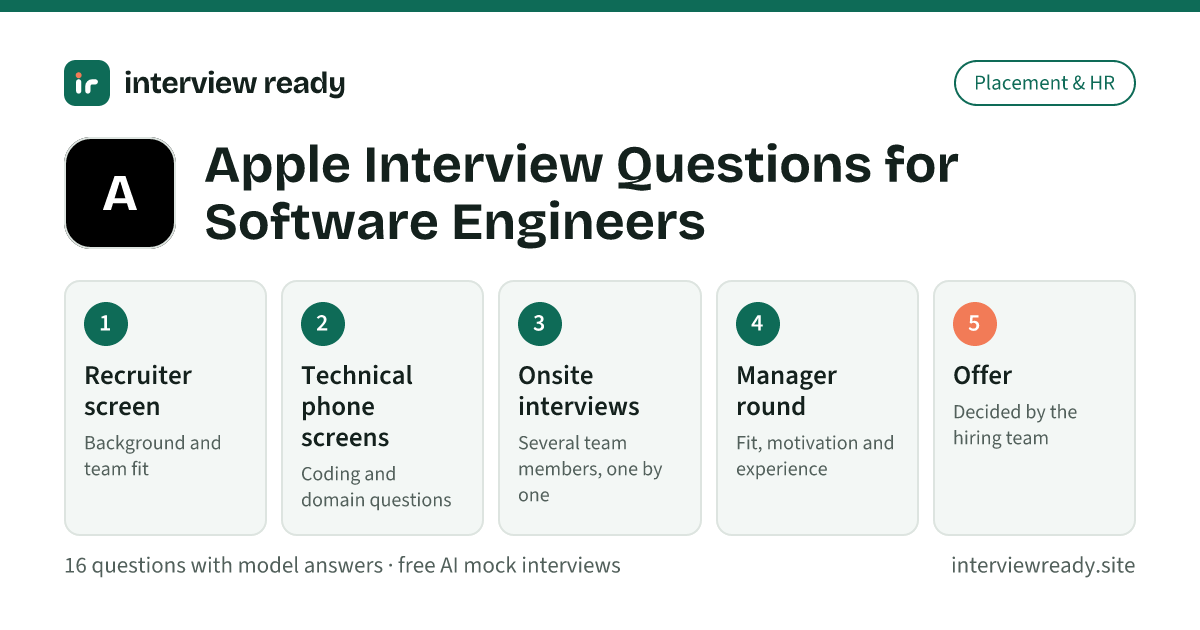
Apple interview process: 1. Recruiter screen (Background and team fit), 2. Technical phone screens (Coding and domain questions), 3. Onsite interviews (Several team members, one by one), 4. Manager round (Fit, motivation and experience), 5. Offer (Decided by the hiring team).
The Apple interview process, step by step.

How to prepare for the Apple interview

Coding round (DSA)

Data structures and algorithms problems solved live, usually in 45 minutes each. Explain your approach before you code.

1. Group a list of words into anagrams.

Answer flow · 3 steps
  1. Words are anagrams if they have the same letters, so use a key that is identical for all of them, such as the sorted word or a count of each letter.

  2. Store groups in a hash map from key to list of words.

  3. Sorting each word gives O(n × k log k); a 26-letter count key gives O(n × k).

from collections import defaultdict

def group_anagrams(words):
    groups = defaultdict(list)
    for w in words:
        groups["".join(sorted(w))].append(w)
    return list(groups.values())

# group_anagrams(["eat", "tea", "tan", "ate", "nat"])
# -> [["eat", "tea", "ate"], ["tan", "nat"]]

2. Check whether a string of brackets is valid.

Answer flow · 4 steps
  1. Use a stack.

  2. Push opening brackets; for each closing bracket, the top of the stack must be the matching opener, so pop it, otherwise the string is invalid.

  3. At the end the stack must be empty.

  4. This is O(n) time and O(n) space.

def is_valid(s):
    pairs, stack = {")": "(", "]": "[", "}": "{"}, []
    for ch in s:
        if ch in pairs:
            if not stack or stack.pop() != pairs[ch]:
                return False
        else:
            stack.append(ch)
    return not stack

3. Implement a queue using two stacks.

Answer flow · 4 steps
  1. Push new items onto an "in" stack.

  2. To dequeue, if the "out" stack is empty, move all items from "in" to "out", which reverses their order, then pop from "out".

  3. Each item moves at most once, so operations are amortised O(1).

  4. This tests whether you understand how data structures compose.

4. Find the first non-repeating character in a string.

Answer flow · 3 steps
  1. Count characters in one pass with a hash map or a fixed array of 26 counts, then scan the string again and return the first character with a count of one.

  2. Both passes are O(n).

  3. For a stream of characters, keep the counts plus a queue of candidates and drop from the front when a character repeats.

5. Remove the nth node from the end of a linked list in one pass.

Answer flow · 4 steps
  1. Use two pointers.

  2. Move the first pointer n steps ahead, then move both together until the first reaches the end; the second is then just before the node to remove.

  3. Use a dummy node before the head so removing the head itself needs no special case.

  4. This is O(n) time and O(1) space.

6. Find the maximum depth of a binary tree.

Answer flow · 4 steps
  1. Recursively, the depth is one plus the larger depth of the two subtrees, with an empty tree having depth zero.

  2. Iteratively, a level order traversal counts the levels.

  3. Both are O(n).

  4. Follow-ups include the minimum depth, which needs care with nodes that have only one child, and checking whether the tree is balanced.

System design and technical depth

Design questions and computer science fundamentals. Low-level design for freshers, high-level design for experienced engineers.

7. How does memory management work in Swift (ARC), and what is a retain cycle?

Answer flow · 3 steps
  1. Automatic Reference Counting tracks how many strong references point to each class instance and frees it when the count reaches zero.

  2. A retain cycle happens when two objects hold strong references to each other, or a closure captures self strongly while self holds the closure, so neither is ever freed.

  3. Break cycles with weak references (which become nil) or unowned references (when the other object always outlives this one), such as [weak self] in closures.

8. How do you run work in the background in iOS, and why must UI updates happen on the main thread?

Answer flow · 3 steps
  1. Use Grand Central Dispatch queues, OperationQueue or Swift concurrency (async/await, tasks and actors) to run slow work such as network calls or image processing off the main thread.

  2. UIKit and SwiftUI are not thread-safe, so updates must happen on the main thread (DispatchQueue.main or @MainActor), otherwise you get crashes or glitches.

  3. Blocking the main thread makes the app freeze.

9. How would you debug an app that crashes only for some users?

Answer flow · 3 steps
  1. Start with crash reports and logs (Xcode Organizer or a crash reporting tool) to find the stack trace, device, OS version and frequency.

  2. Try to reproduce on the same configuration, add logging around the failing code, and check for causes such as force-unwrapped optionals, threading issues, memory pressure or unexpected server data.

  3. Fix the root cause, add a test, and monitor after release.

10. How would you design photo syncing across a user's devices?

Answer flow · 4 steps
  1. Upload new photos from each device to cloud storage with metadata and a unique ID, and record changes in a per-user change log.

  2. Other devices fetch changes since their last sync token and download thumbnails first, full images on demand.

  3. Handle edits as new versions, deletions as tombstones, and conflicts with clear rules.

  4. Respect privacy with encryption and minimise battery and data use by syncing on Wi-Fi and while charging when possible.

11. What is the difference between a class and a struct in Swift?

Answer flow · 4 steps
  1. Structs are value types: assigning or passing one copies it, which makes them safe from shared mutable state, and they are preferred in Swift for models.

  2. Classes are reference types: copies point to the same instance, they support inheritance and deinitialisers, and they are managed by ARC.

  3. SwiftUI views are structs.

  4. Use classes when you need shared identity or inheritance, such as a shared data store.

Behavioural round

Questions about your past work and how you behave in a team. Answer with real stories using the STAR method.

12. Why do you want to work at Apple?

Answer flow · 3 steps
  1. Be specific and genuine: mention products you use and what you admire, such as attention to detail, privacy or accessibility, and connect it to the team's work.

  2. For example: "I care about building software that just works for users.

  3. Apple's focus on privacy, such as on-device processing, is the kind of engineering I want to learn, and this team's work on the camera app is something I use daily."

13. Tell me about a time you paid great attention to detail.

For example: "Before submitting our final-year app, I tested it on five devices and found the layout broke on small screens and in large text sizes. I fixed both, and our examiner specifically mentioned how polished it felt." Apple values craftsmanship and quality.

14. Tell me about a time you worked with another team to deliver something.

Describe the goal, how you communicated across teams, the challenges such as different priorities, and the result. Apple products involve close collaboration between hardware, software and design teams, so this matters.

15. How do you handle confidential information?

Answer flow · 3 steps
  1. Apple is famous for confidentiality.

  2. Say that you share information only on a need-to-know basis, never discuss unreleased work outside the team or on social media, and follow security policies carefully.

  3. Give an example if you have handled confidential data before, such as in an internship.

16. Tell me about a product decision you disagreed with.

Show user focus and respectful disagreement: what you thought was wrong, the evidence you shared, and how you supported the final decision. Apple values strong opinions backed by care for the user experience.

Ready to test yourself?Pick your topics and level, answer by voice or text, and get instant feedback. Free.
Start a mock interview

Related skill interview questions

HR round, company and bank interview questions

Bank and government exams

Interview questions by field

Company names are trademarks of their respective owners. Interview Ready is an independent practice site and is not affiliated with or endorsed by any company listed here.